Why Simulations Make the Best Team-Building Games
Most of us have been to at least one team-building event that felt like a box being checked. Everyone has tried the escape room, the trivia night, or the ropes course, shared a few laughs, and then headed back to the same meetings, the same silos, and the same habits on Monday.
There's nothing wrong with having fun together, and shared experiences do build trust. But the best team-building games do more than that. They help teams practice the way they work together, so the connection and the skills carry back into the job.
Business simulations offer everything people want from team-building games, including energy, cooperation, and a little friendly competition, while mirroring the real decisions, pressures, and trade-offs teams face at work.
What are team-building games?
Team-building games are structured activities that bring colleagues together to solve a challenge, complete a task, or compete as a group. Organizations use them for corporate team building, onboarding new teams, kicking off leadership programs, and bringing together people who don't usually work side by side.
What should team-building games achieve?
Whatever the format, the goals of most team-building activities are similar. A good team-building game should:
Be fun and engaging, so people want to participate rather than feeling obligated to
Encourage cooperation, with a shared goal that no one can reach alone
Build trust and communication, giving teammates a reason to listen, share ideas, and rely on each other
Strengthen team dynamics, helping people understand how their colleagues think, decide, and contribute
Connect people across the organization, creating relationships that make collaboration easier long after the event
Where traditional team-building activities fall short
Escape rooms, cooking classes, scavenger hunts, and volunteer days can all create memorable shared experiences, and they do a good job of sparking conversation and trust. The challenge is what happens next.
Because most traditional team-building activities have little to do with the work itself, the lessons rarely make it back to the office. Cracking a code in an escape room doesn't tell a team much about how they'll handle a budget cut, a missed deadline, or a disagreement between two functions.
Five reasons why simulations make the best team-building games
A business simulation is a team-based game that places participants inside a realistic, dynamic business environment. Teams run a virtual company, lead a simulated team, or negotiate with competing stakeholders, making decisions round after round and living with the results. Here’s how simulations deliver on the goals of a good team-building game, and where they go further.
They're fun and competitive
Simulations are time-bound, team-based, and gamified, with a ticking clock and teammates depending on every choice. Teams compete against each other for customers, talent, or resources, and they can see how they stack up. That friendly competition gets people invested quickly.
They require real cooperation
No one wins a simulation alone, because each person often takes on a different role, such as CEO, finance lead, or head of sales, and the team has to pool information, debate trade-offs, and agree on a plan under pressure.
They reveal how a team works together
Because the pressure feels real, simulations surface the dynamics that shape how a team performs: who speaks up, who holds back, how decisions get made, and what happens when people disagree. Those moments become the starting point for the debrief.
They mirror the workplace
The challenges are modeled on real business situations, from interpreting financial data and managing a team's performance to aligning stakeholders with competing interests. Teams practice the same skills they need on the job, including business acumen, cross-functional decision-making, and team management.
They turn the experience into learning
In Abilitie simulations, a skilled facilitator leads a debrief between rounds and at the end of the experience, helping teams make sense of what happened and connect it to their real work. That reflection is what turns a fun afternoon into lasting behavior change. One participant in AMD's leadership program summed it up: "The business simulation was very useful for team-building and understanding the executive experience."
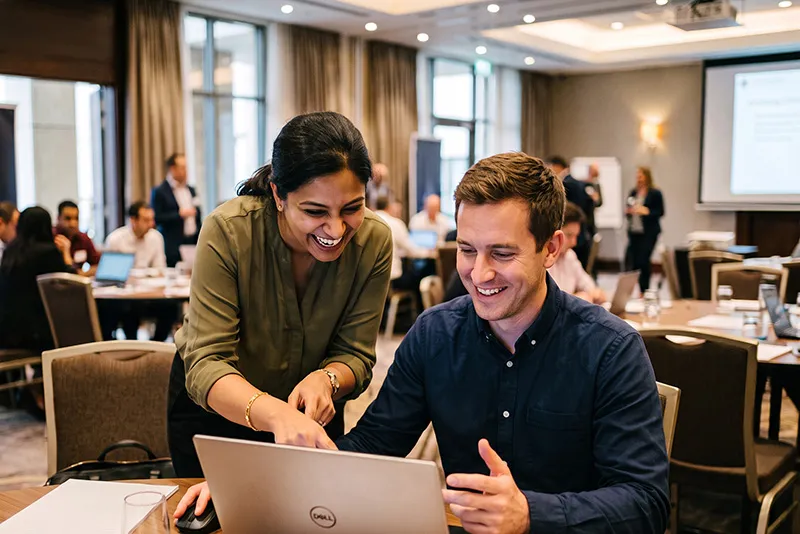
Abilitie simulation participant
Examples of simulation-based team-building games
Different simulations build different team skills, so the right choice depends on what you want your team to get better at together.
Running a company together: In Enterprise Challenge, cross-functional teams with limited resources compete for customers and top talent in a dynamic marketplace while responding to unexpected market events.
Building influence and trust: In Influence Challenge, participants step into the town of Grassagreena as City Council Members, balancing the interests of their own stakeholders while negotiating with others in an environment of "coopetition."
Leading a team under pressure: In Management Challenge, small teams compete in a fast-paced business environment while coaching a virtual team, driving engagement, and balancing motivation with performance.
Shorter team challenges: Two-hour Case Challenges tackle a single realistic business dilemma, making them a good fit for team offsites, kickoffs, or a recurring team-building rhythm.
These experiences can be delivered in person or virtually, so they work for teams in one room or spread across time zones. Afua Akoto at Goodwin described the effect: "Getting a group of roughly 40 midlevel associates to close their laptops, put their phone on silent, and be fully immersed in a half-day simulation on negotiation skills is no easy task, however, partnering with the Abilitie team and utilizing their Influence Challenge helped us do just that."
How to get the most from a team-building simulation
A little planning helps teams get more out of the experience.
Mix up the teams. Group people from different departments, locations, or levels. Working through a high-pressure challenge together creates bonds with colleagues people might never have worked with otherwise.
Help people connect before the event. A short pre-event survey about professional interests, leadership challenges, and a fun fact or two makes it easy to form teams and gives participants something to talk about from the start.
Protect time for the debrief. Make sure a facilitator has time to help teams reflect on what worked, what didn't, and what they'll do differently back at work.
Team building that carries back to work
The best simulations leave teams more connected and better prepared for the work ahead. When teams laugh, compete, and solve hard problems together in a setting that mirrors their real work, the trust they build and the skills they practice come back to the office with them.
Want to see what a simulation-based team-building game looks like? Sign up for a hands-on play session or schedule time with one of our experts to find the right experience for your team